
NEWS BLOG

Making Your Comiket Trip a Success: Words to Know, What to Do, Why
December 13, 2025
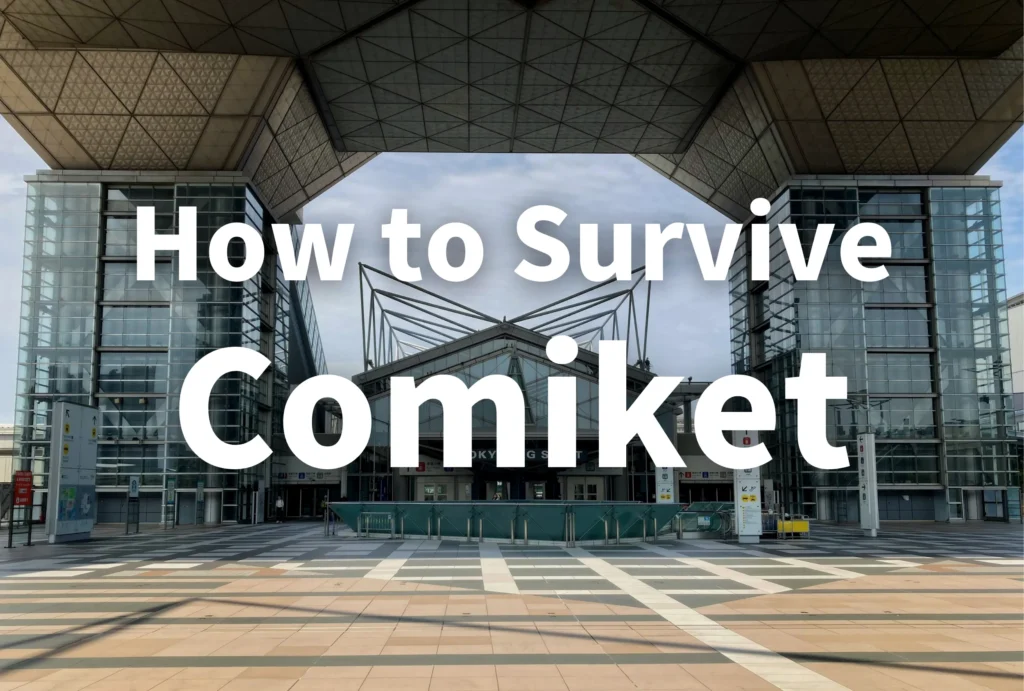
If you’ve watched anime for any length of time, you’ll be familiar with fandoms. Dragonball, Bleach, Berserk, it doesn’t matter what you watch; if there’s a popular series, there’s a fandom for it. Often, these fandoms just discuss things with each other. Other times, though, they may put their creative skills to the test and make “Doujinshi” (self-published works). But for the enterprising and social, the creative and crafty, one event stands above all: Comiket, Japan’s Comic Market, the absolute center of gravity for otaku culture and anyone serious about Japanese fandom.
The largest fan convention in the world, for 50 years now, audiences from all over Japan (and now the globe!) have gathered here to hawk goods, dress up, and meet with one another. A hardcore fan of any Japanese series would be remiss not to attend at least once. Thankfully, it’s easier than ever to attend as a foreigner interested in otaku travel and the deeper layers of otaku Japan, so today we’ll be going over exactly what Comiket is, some good words to know, and how to make the most of your time at Tokyo Big Sight, where the event takes place.
What is Comiket?
Comiket (short for “Comic Market”) started in 1975 with barely 32 circles and around 700 attendees crammed into a small space in Tokyo. It was a gathering of misfits desiring to share their doujinshi with each other. From there, it exploded. By the 1980s, it had already broken 10,000 attendees. By the mid-90s, it had surged past 300,000 people, forcing the move to Tokyo Big Sight, where it has usually taken place since. In recent years, peak year-end Comiket events have hit 500,000–750,000 total visitors across the two days, making it the largest fan convention on earth by sheer density. It’s also one of the few major pop-culture events still run by volunteers, not corporations. It has a “not-for-profit” spirit, which I feel is fundamental to its atmosphere.
You can think of it as the otaku Hajj: a twice-a-year pilgrimage where thousands of worshippers move through the halls with a religious fervor, all releasing the work they’ve poured months into. The format is simple. Buy, sell, survive. Yet the environment demands more than that. It’s chaotic, savage. Almost like a jungle, where might makes right. Lines move like animals. Creators see thousands of buyers. The machine must run smoothly. You have but seconds to interact with the vendors. Your words will matter. You don’t need to speak perfect Japanese, but you do need to speak “Comiket.” Without it, you’re another body to be stepped on in the stampede. Any serious Comiket guide will tell you the same thing: respect it or be crushed by it.
What words should I know
Kaiwai 〇〇界隈(かいわい)
A “scene” or “sphere” around a topic. Think of it as the neighborhood of a fandom. Otaku circles organize themselves by 界隈, not by broad genres, so knowing your scene matters when navigating any corner of Japanese fandom.
Numa 沼(ぬま)
“The swamp.” When you fall in, you don’t climb out. If someone tells you a certain pairing or series is a 沼, they’re warning you about your wallet. It’s a classic problem at Comic Market.
Toutoi 尊い(とうとい)
“Precious.” Just as Gollum loved his ring, you love your own and only waifu or husbando. They are your life. They are your everything. You’ll hear 尊い all over the cosplay areas too.
Oshi 推し(おし)
“The one I push.” Your chosen one. Your favorite character, talent, or unit. Entire sections of Comiket are arranged by 推し. Do you really love your waifu if you can’t call her your Oshi?
Gachisei ガチ勢(がちぜい)
The serious tier. The lifers. If someone says a line is full of ガチ勢, watch out. They’re religious zealots and you can’t take them lightly.
Jirai 地雷(じらい)
“Land mines.” Content you absolutely cannot tolerate. Pairings, depictions, themes, etc. Think of it like a “trigger warning”. Useful if you’re checking whether a book is safe for you before buying.
Shinkan 新刊(しんかん) / Kikan 既刊(きかん)
New release vs. previous works. You ask for 新刊 first. You flip through 既刊 after the rush.
Hanpu 頒布(はんぷ)
Event-specific distribution. If a sign says 頒布終了, it’s gone. Finished. Move on.
Retsu 列(れつ)
A line. Sometimes two lines. Sometimes a fake line forming behind a real line. If staff tells you to move, just move.
How can I make the most of my time?
- 1. Know your targets before you arrive.
The Comiket catalog exists for a reason. Find your circles, mark your routes, and memorize them. Do not “wander to see what’s there”. You will get lost and run out of time. - 2. Bring cash. Break it down.
¥100 coins and ¥1,000 bills. Circles aren’t convenience stores. They’re two exhausted artists with a cash box. - 3. Keep your Japanese short and functional.
- ・新刊ありますか?
(Shinkan Arimasuka?, “Do you have your new release?”)
・既刊も見せてください。
(Kikan Mo Misete Kudasai, “Please show me your older works too.”)
・これください。
(Kore Kudasai, “This one, please.”)
You’re not here to chat. Neither are they. This is how real otaku culture handles transactions.
- 4. Respect the line.
Comiket survives on mutual respect and cooperation. Don’t cut, don’t drift, don’t argue. Staff hand signals are law. - 5. Travel light.
You don’t need half your backpack. You need water, a battery pack, and enough space for books. Your back will thank you. - 6. Don’t block tables.
Buy your thing, move aside, then sort it out. Every second you linger is a second someone else has to wait. - 7. Compliment simply.
A plain, old 素晴らしいですね or 絵がきれいです is enough. They’re just happy you’re buying their works. You don’t need to do more. - 8. Watch your stamina.
Winter Comiket is cold, dry, and crowded. Summer Comiket is hot, wet, and also crowded. Hydrate, eat something, keep moving. Fatigue is the enemy.
Think of it like climbing a mountain. You don’t have to win it. You just need to survive it.
Summary
Comiket demands respect. You need to know what it is to make the most of it. If you have discipline, awareness, and humility, you will be greatly rewarded. Hence, you must know the vocab, know the rules, and understand that the vendors are just there to do their thing. It’s, after all, a pilgrimage. Sacred rites must be obeyed, and sacred words must be invoked. Pilgrims who can do this will be well-rewarded, while those who cannot will find their visit to be less than what it’s worth.
For everything else, Tabibiyori can help you get the most out of it: Travel, planning, and all.

If you liked this article,
give it a like!



-

"Beyond Tsukiji!? The Grilled Fish Delight at Shinpachi Shokudo
No need to travel all the way to Tsukiji or...
-
Halloween in Shibuya: What to Know, What to Avoid, and How to Enjoy It
You’ve heard of it. We’ve heard of it. Everyone has...
-
Experience Tokyo With TABIBIYORI – Our Signature Local Tours
Tokyo is one of the world’s greatest cities — but...
-
Washing Money
目次 1. Have You Ever Tried Washing Money at a...
-
🌸 How to Book a Tour with TABIBIYORI – An Easy 3-Step Guide!
目次 📲 Contact Us via Your Preferred Messaging App or...

-
Experience Tokyo With TABIBIYORI – Our Signature Local Tours
Tokyo is one of the world’s greatest cities — but...
-
Washing Money
目次 1. Have You Ever Tried Washing Money at a...
-
Toyosu Market – The New Food Capital of Tokyo
Toyosu Market is Tokyo’s new central wholesale market, relocated from...
-

Food Culture and Specialties at Tsukiji Market!
Tsukiji, known as Tokyo’s good culture center, is a treasure...
-
5 Unique Museums That You Can Find in Tokyo
Tokyo is home to some of the most prestigious museums...